
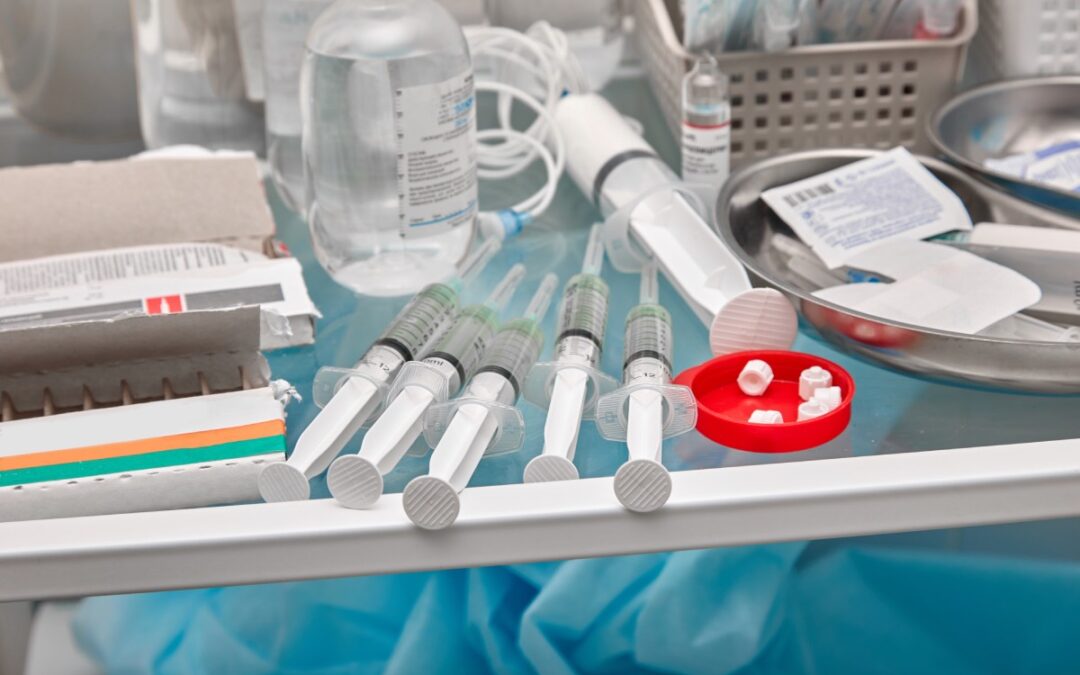
Modern surgery relies on many medications to ensure patient safety, control bleeding, prevent infection, and support healing. Medications may be synthetic, extracted from bacteria, developed from plants, or derived from animals. Although animal-derived medications play vital roles in the operating room (OR) and other areas of medicine, they raise ethical, religious, and safety considerations.
One of the most common animal-derived medications used in the OR is heparin, an anticoagulant that prevents blood from clotting too quickly. Heparin is essential during many procedures, especially in heart surgery and when patients are connected to machines that circulate blood outside the body. Most medical heparin is derived from the intestinal tissue of pigs—without it, surgeons would face serious challenges in preventing dangerous clots during complex operations (1,2).
After heparin is used, its effects sometimes need to be reversed to allow normal blood clotting. To this end, protamine is frequently used, especially after cardiac surgeries, when patients no longer need strong blood-thinning effects. However, it is commonly derived from fish (often salmon) sperm. Although effective, it can cause allergic reactions in some individuals, particularly those with fish allergies, which must be considered by the surgical team (3–5).
Animal-derived products are also used to control bleeding and support tissue repair. Some surgical sealants and sponges contain gelatin made from cows or pigs. These materials help absorb blood and promote clot formation at surgical sites. Collagen-based products, often derived from bovine or porcine sources, are also used to strengthen tissues and support wound healing. These materials dissolve naturally in the body over time and reduce the need for additional stitches in some cases (6,7).
In some surgeries, especially heart valve replacement, biological implants from animals are used. Valves taken from pigs or made from cow tissue are shaped and treated so they can function inside the human heart. These biological valves are often chosen because they behave more like natural human valves and usually do not require long-term use of strong blood-thinning medication. However, they may wear out faster than mechanical valves and eventually require replacement (8–10).
Ethical, religious, and cultural considerations are important when using animal-derived medications, as some patients may have ethical beliefs, dietary practices, or religious restrictions that require them to avoid products made from certain animal sources. Hospitals increasingly recognize the need to inform patients about the origins of medications and to offer suitable alternatives when they are available and medically appropriate. At the same time, strict processing, purification, sterilization, and testing standards are applied to animal-derived medical products to prevent disease transmission. Although modern regulations have greatly reduced these risks, ongoing monitoring and quality control remain essential to ensure patient safety (11–14).
Animal-derived medications and materials represent important tools in the OR, supporting a range of processes, including but not limited to blood control, tissue healing, and organ replacement.
References
1. Oliveira, S. N. M. C. G. et al. Anticoagulant Activity of Heparins from Different Animal Sources are Driven by a Synergistic Combination of Physical-chemical Factors. TH Open 6, e309–e322 (2022). DOI: 10.1055/a-1946-0325
2. Research, C. for D. E. and. FDA Encourages Reintroduction of Bovine-Sourced Heparin. FDA https://www.fda.gov/drugs/pharmaceutical-quality-resources/fda-encourages-reintroduction-bovine-sourced-heparin (2026).
3. Liu, S. et al. Isolation and Purification of Protamine from the Cultured Takifugu flavidus and Its Physicochemical Properties. Molecules 29, 263 (2024). DOI: 10.3390/molecules29010263
4. Gill, T. A., Singer, D. S. & Thompson, J. W. Purification and analysis of protamine. Process Biochemistry 41, 1875–1882 (2006). DOI: 10.1016/j.procbio.2006.04.001
5. Applefield, D. & Krishnan, S. Protamine. in StatPearls (StatPearls Publishing, Treasure Island (FL), 2025).
6. Boursier, M. et al. Biocompatible Glues: Recent Progress and Emerging Frontiers in Surgical Adhesion. Polymers 17, (2025). DOI: 10.3390/polym17131749
7. Administration (TGA), T. G. Cryolife Medical (Australia) Company Pty Ltd – BioGlue Surgical Adhesive – Surgical adhesive/sealant, animal-derived (431570) | Therapeutic Goods Administration (TGA). https://www.tga.gov.au/resources/artg/431570 (2023).
8. Jun 6, L. R. & 2024. Types of Replacement Heart Valves. www.heart.org https://www.heart.org/en/health-topics/heart-valve-problems-and-disease/understanding-your-heart-valve-treatment-options/types-of-replacement-heart-valves.
9. Biological Implant – an overview | ScienceDirect Topics. https://www.sciencedirect.com/topics/materials-science/biological-implant.
10. Butany, J. et al. Biological replacement heart valves: Identification and evaluation. Cardiovascular Pathology 12, 119–139 (2003). DOI: 10.1016/s1054-8807(03)00002-4
11. O’Sullivan, R. & Kearsley, R. Animal products in anaesthesia: navigating complex requests. British Journal of Anaesthesia 128, e2–e4 (2022). DOI: 10.1016/j.bja.2021.09.019
12. Cheng, M. et al. Regulatory considerations for animal studies of biomaterial products. Bioact Mater 11, 52–56 (2021). DOI: 10.1016/j.bioactmat.2021.09.031
13. Duarte, A. C. et al. Animal-derived products in science and current alternatives. Biomaterials Advances 151, 213428 (2023). DOI: 10.1016/j.bioadv.2023.213428
14. Wang, J. R., Oh, E., Aronow, B. & Bernstein, W. K. The unseen animal behind medicine: exploring considerations of animal-derived medications and anaesthetics in today’s landscape. BJA Open 13, 100360 (2024). DOI: 10.1016/j.bjao.2024.100360


Recent Comments